
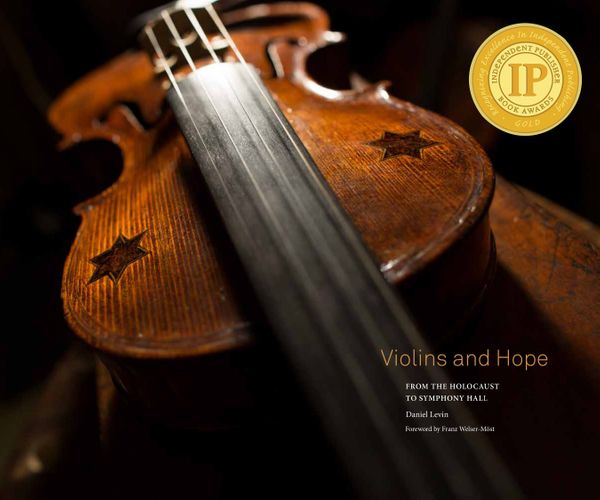
Violins and Hope | From the Holocaust to Symphony Hall
Recognition
Daniel Levin, in his magnificent book, Violins and Hope, brings the story full circle by showing the world how Amon Weinstein restores violins that survived such a dark past so they can sing forever."
—Joshua Bell, violinist
"Any violin ever made is the embodiment of birth and hope. From the shape of its body to the strength of its bow, the images are rendered with love. To see them is to be informed by time. The time Daniel Levin took to make the pictures and the time Amnon Weinstein takes to restore the violin. Each step is speaking of patience, crescendo, and singular symphonic tone. Tone is the rapture that embraces us collectively and alone."
—Larry Fink, photographer / author of Boxing, Night at the Met, Primal Elegance, Social Graces, and The Forbidden Pictures
"Like a rich tapestry that keeps unfolding to reveal unexpected layers and designs, Levin's book intertwines the stories behind the violins he photographed at Weinstein's studio with important historical figures and events."
—Eve Glover, Jerusalem Post Magazine
"Like Amnon’s restored violins, Daniel’s book is a lasting gift to us all."
—Franz Welser-Möst, Conductor / Music Director, The Cleveland Orchestra
"The noble and righteous quest of restoring to life and to the concert-hall Jewish violins that survived the Holocaust, although many of their owners perished, is movingly narrated by the insightful commentaries and richly toned, intricately layered photographs of Daniel Levin. Levin's Violins and Hope takes us into the Tel Aviv workshop of the story's protagonist, renowned Israeli luthier Amnon Weinstein, and conveys not just his tools and methods, but the heart and soul of this extraordinary man and his vision."
—Barbara Tannenbaum, Curator of Photography, Cleveland Museum of Art
"Violins and Hope is a fascinating and moving documentation of how sounds of memory not only connect people and their stories across time and space, but also possess the power to convey the message of hope as an aspect of Holocaust remembrance."
— Maoz Azaryahu, Director of the Herzl Institute for Zionism, University of Haifa
Weinstein, a renowned Israeli luthier (violin maker) who was trained by three of the most revered Italian luthiers of the twentieth century, had a vision many years ago to restore violins that survived the concentration camps and ghettos of World War II, even when their owners often did not. His “Violins of Hope” project may be one of the most creative, effective, moving, and magnificent approaches to understanding the Holocaust and how one heals from such pain and loss.
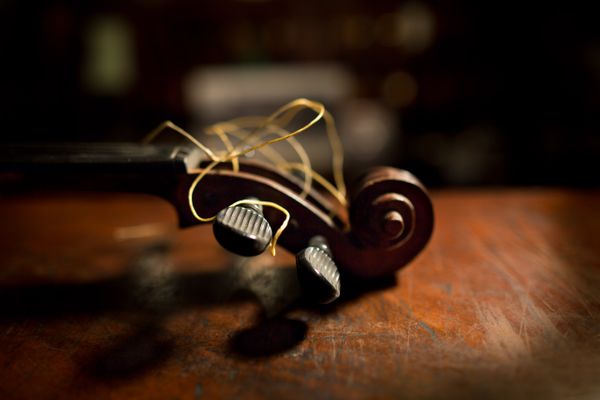
Daniel Levin is the first photographer to depict Amnon’s workshop in Tel Aviv, his one-of-a-kind collection of violins that survived the Holocaust, and his artful process for restoring them. Through hauntingly beautiful photographs and compelling text, Violins and Hope becomes both an artful rendering of a very special man and a revelation of the ethereal, as we see how Amnon fulfills his dream of transforming tragedy into triumph in the most incisive and powerful way imaginable: bringing violins of the Holocaust back to life. Under Levin’s care, the ambiance and idiosyncrasies of Amnon’s workshop come alive, and the photographer’s uncanny ability to celebrate both place and process through the beauty of light is nothing short of remarkable.
Amnon has already restored eighty-six violins to their highest playable condition, and they have been used in acclaimed performances by symphonies to packed concert halls throughout the world, beginning in Istanbul in 2001. Purposefully, Amnon makes certain that young violinists as well as the world’s most famous virtuosos perform on his restored violins. In doing so, it’s as if the past owners of the violins come back to life and fill our minds and bodies and hearts with joy and remembrance.
The book’s foreword is written by Austrian-born Franz Welser-Möst, Music Director of the Cleveland Orchestra since 2002 and one of the most acclaimed conductors of the twenty-first century.
The book concludes with the author’s interview with Assi Bielski Weinstein, Amnon’s wife and the daughter of Asael Bielski, the famous partisan fighter who, along with his brothers, saved 1,247 Jews in Belarus during World War II. Assi talks about the history of violins in Jewish life and during the Holocaust, the Bielski partisans, and the enduring legacy of the “Violins of Hope” project.